What information should you get at handover?
Ask for the installed system’s product names, cleaning instructions, and contact for service questions. The decorative color alone will not identify the finish. A future owner or cleaner should be able to find the instructions without guessing what was installed.
- When normal cleaning may begin.
- Which cleaner and dilution are approved.
- Which brushes, pads, or machines may be used.
- Any restrictions on mats, chemicals, or heavy equipment.
- How to report a stain, worn area, or loss of adhesion.
Keep a copy with the invoice and save a photograph of the finished floor. That gives you a reference if you later need to explain where a change appeared.
What should routine care accomplish?
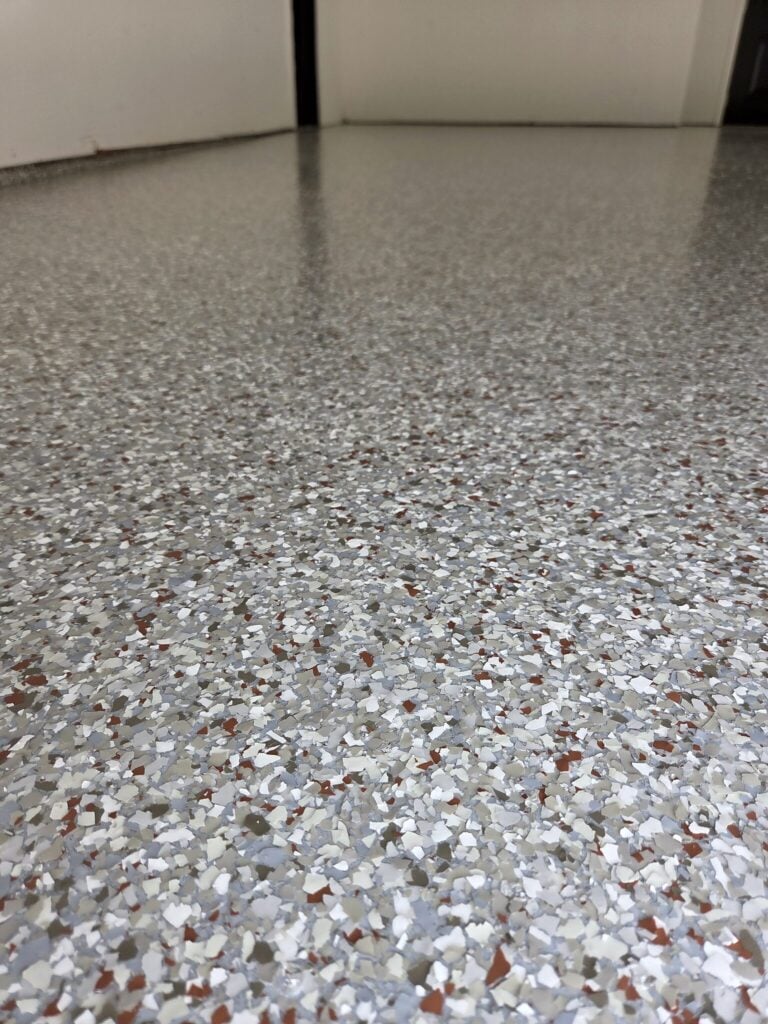
The goal is to lift dirt off the floor, not push gritty water into another area. Sherwin-Williams describes a sequence of sweeping, applying cleaner, agitating, allowing dwell time, and removing the solution. For small textured floors it identifies a squeegee or wet vacuum for recovery. Use tools compatible with your own finish.
| Step | What to do |
|---|---|
| 1. Remove loose dirt | Sweep before applying liquid so grit is not worked into the finish. |
| 2. Apply and agitate | Use the specified dilution and compatible tools; do not improvise a stronger mixture. |
| 3. Allow contact time | Follow the cleaner’s instructions. The cited Sherwin-Williams guide lists 5–10 minutes for its recommended process; that is not a universal rule for every cleaner. |
| 4. Recover the solution | Remove the dirty liquid with equipment suited to the texture, rather than leaving it to dry in place. |
When can you first scrub a new coated floor?
Do not equate walking access with permission to scrub. Sika’s general maintenance guide specifies seven days of cure at 70°F before scrubbing and notes that maximum resistance can take up to 14 days. Those figures illustrate why the handover instructions matter; they are not a promised cleaning schedule for every epoxy or polyaspartic system.
Source: Sikafloor general maintenance guide, page 2 (PDF), reviewed September 24, 2026; no revision date shown. For a different product or cooler conditions, use its specific instructions. See also walking, parking, and cure milestones.
How should you handle winter mess?
Plan for where wet boots, snow-covered vehicles, and tracked-in debris will enter. Discuss those areas before installation so appearance, texture, and care expectations are aligned. Afterward, follow the approved process for removing the mess instead of allowing it to dictate an improvised cleaning method.
Ask whether any proposed mat is compatible with the coating and how the area beneath it should be maintained. A mat is not a substitute for checking the floor. Pay attention to wet walking routes and keep access clear while cleaning; no decorative pattern makes a wet floor automatically slip-proof.
What should you avoid experimenting with?
Do not assume a household degreaser, abrasive pad, solvent, or pressure washer is suitable because it worked on bare concrete. Get approval for the product and method first. The question is not simply whether it removes a mark, but whether it changes the finish.
If an unfamiliar chemical is spilled, identify it and follow its safety instructions as well as the floor manufacturer’s guidance. Do not mix cleaning chemicals. If you cannot handle the spill safely, keep people away and obtain appropriate help rather than trying a sequence of stronger cleaners.
For ordinary marks, describe the substance and send a photograph before attempting an unapproved treatment. This gives the installer a chance to distinguish a cleaning issue from damage that needs another response.
When does a floor need attention beyond cleaning?
| Observation | Useful next step |
|---|---|
| A persistent mark | Identify what contacted the floor and ask about an approved treatment. |
| A newly damaged area | Photograph it and report the location and timing. |
| A lifting or bubbling area | Request assessment instead of coating over it. |
| A change in texture or sheen | Review use and cleaning history with the installer. |
A photograph can start the conversation but does not prove the cause or establish warranty coverage. Keep records without disturbing the area unnecessarily. Ask whether it needs an in-person inspection. Lifting often traces back to moisture or preparation; see epoxy floor downsides and how to avoid them.
Can maintenance extend the useful life of the finish?
A consistent care plan helps protect your investment, but it is not a basis for promising a fixed number of years. Traffic, the installed system, the substrate, and actual use all belong in the conversation. Get advice before adding a maintenance coat; compatibility and preparation still matter.
If you are planning a new project, ask Midwest Painting Pros about care expectations while discussing floor-coating options. Choosing a finish includes choosing a maintenance routine you are comfortable living with.