| Downside | Why it happens | How it is avoided |
|---|---|---|
| Slippery when wet | Smooth, glossy resin has low traction when water or slush is on it | Texture or anti-slip aggregate built into the wear coat |
| Yellowing in sunlight | Many epoxies change color under UV light | A UV-stable polyaspartic or similar topcoat where sun reaches the floor |
| Peeling or bubbling | Moisture in the slab, contamination, or concrete that was not mechanically prepared | Moisture testing and grinding or shot blasting before primer |
| Cracks showing through | Joints and cracks that move keep moving under the coating | Filling static cracks; honoring moving joints with flexible sealant |
| Downtime | Two-part resins need time to cure, longer when it is cold | Scheduling around the product’s cure times at the actual temperature |
Is an epoxy garage floor slippery?
It can be, when it is wet. Sika publishes a coefficient of friction of 0.99 dry but only 0.25 wet for its smooth, high-gloss clear polyaspartic finish. Sikafloor-515 PDS. Even the makers of one-part floor paint warn that “all floor coatings may become slippery when wet.” GarageGuard TDS.
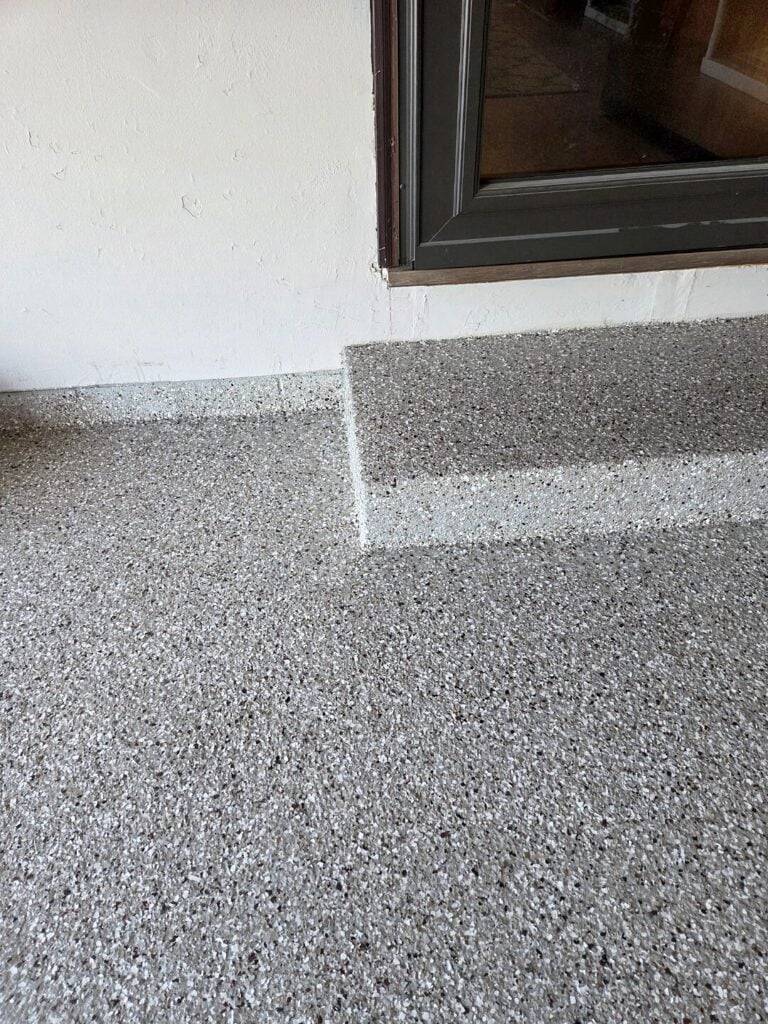
That is why a Wisconsin garage, where snow and slush come in on every car, should be specified with intentional traction: the flake texture itself plus an anti-slip aggregate in the topcoat where needed. Ask how traction is built in, not just which color is chosen.
Does an epoxy floor turn yellow?
It can. Many epoxies change color with sun exposure, which is why manufacturers formulate and market epoxies specifically for better UV color stability. Sika, for example, describes added resistance to “ultra violet light colour change” for Sikafloor-217 in “traditional interior seamless flooring installations.” Sikafloor-217 PDS (PDF).
Where sunlight reaches the floor, through an open garage door or windows, a UV-stable topcoat protects the color. Sika lists “excellent UV resistance” for its polyaspartic Sikafloor-515, which is designed as a clear topcoat over a flake broadcast. Sikafloor-515 PDS. See epoxy vs polyaspartic for the full comparison.
Why do epoxy floors peel or bubble?
The two big causes are moisture and preparation. Sika’s polyaspartic system, as one example, must not be applied above 4% moisture by mass on its specified concrete moisture meter, with no vapor drive at the time of application, and only after the slab is shot blasted or mechanically prepared to ICRI CSP 3–4. It also requires the slab to be at least 5°F above the dew point, because condensation can cause adhesion failure. Sikafloor-515 PDS.
A floor rolled onto damp, smooth or oily concrete can look fine for a season and then lift. Testing the slab and grinding it are the parts of a professional install you do not see once the flakes are down. See concrete moisture before coating.
Can you epoxy a garage floor with cracks?
Yes, if each crack is treated by type. Sherwin-Williams’ resin flooring guidance separates static joints and cracks, which are cleaned out and filled with a compatible filler, from dynamic joints that move with the slab, which “must be honored by saw cutting through the finished floor system and filling with a flexible joint sealant.” It warns that not honoring moving joints “can lead to cracks in the surface.” Sherwin-Williams: Dynamic and Static Joints.
A coating also protects a sound slab; it does not stop frost heave or repair concrete that is breaking apart. Severe heaving, sunken sections or crumbling concrete need concrete work first.
How long before you can use it?
Expect foot traffic within hours to a day and full cure in about 5 to 10 days, depending on the product and the temperature. For one epoxy example, Sikafloor-217 allows foot traffic after about 8 hours and full cure after about 7 days at 68°F, but about 24 hours and 10 days at 50°F. A fast-curing polyaspartic like Sikafloor-515 allows foot traffic after about 4 hours and full cure after about 5 days at 68°F. Sikafloor-217 and Sikafloor-515 data sheets. See when you can park on a coated garage floor.
What is better than epoxy for a garage floor?
For most garages, a flake system finished with a polyaspartic topcoat. Polyaspartics cure faster and resist UV color change; Sika lists foot traffic after about 4 hours and full cure after about 5 days at 68°F for Sikafloor-515, along with “excellent UV resistance.” Sikafloor-515 PDS. Many professional floors combine both: an epoxy base for build and a polyaspartic topcoat for wear and sunlight. See epoxy vs polyaspartic.
Is an epoxy garage floor worth it?
For a garage you park in every day, yes: a properly installed system resists salt, oil and hot tires, hides dirt, and cleans with a mop. Our planning range for a two-car garage of about 400–576 square feet is $2,600–$5,800; prep, moisture and the system selected drive the price. If the floor is lightly used, a well-prepared floor paint may be enough; see garage floor paint vs epoxy.
How Midwest Painting Pros avoids these problems
Every floor estimate starts with the slab: existing coatings, cracks, moisture and sunlight. We grind the concrete, treat cracks and joints by type, build traction into the wear coat, and specify a UV-stable topcoat where sun reaches the floor. The written estimate names each layer and the return-to-use dates. Learn more about epoxy and garage floor coatings and caring for a coated floor.