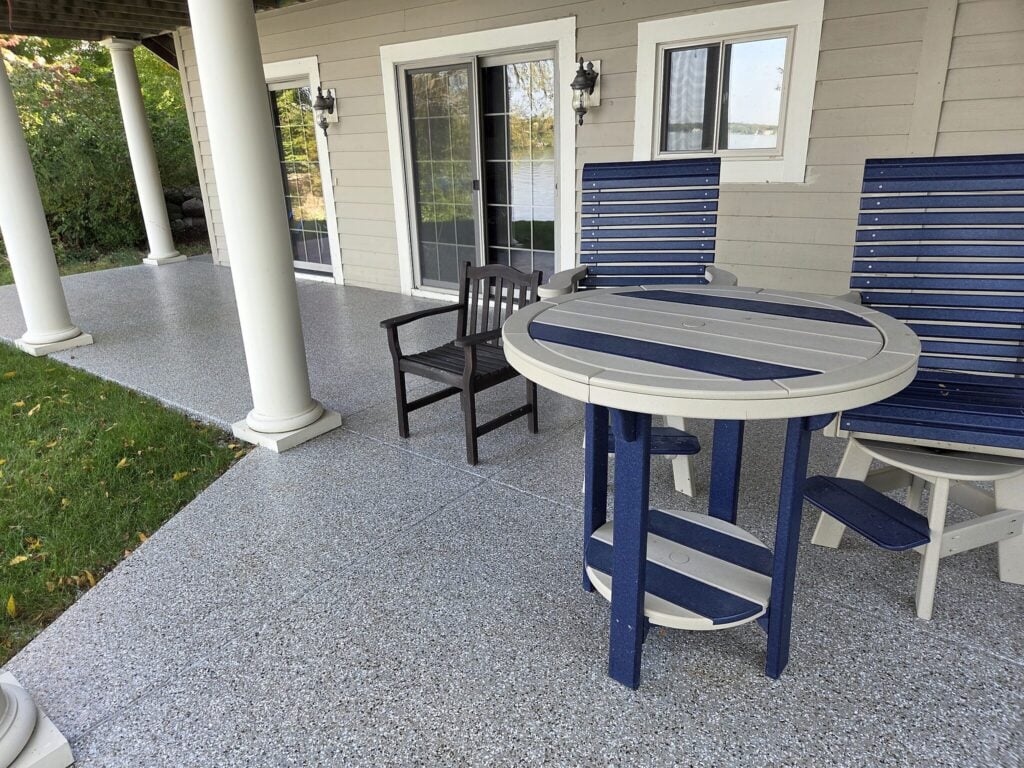
What makes an outdoor floor coating different?
Four things: sunlight, water and freeze-thaw, moisture from the ground, and traction.
- Sunlight. A chemistry that is not UV-stable can yellow and chalk outdoors. Exterior flake floors use a UV-stable aliphatic topcoat such as a polyaspartic.
- Water and freeze-thaw. Rain, snowmelt and Wisconsin’s freeze-thaw cycles test the bond and the concrete underneath.
- Moisture from the ground. Outdoor slabs sit on soil, so moisture can move up through them. Systems such as Sikafloor-515 require that there be no vapor drive at application.
- Traction. A smooth, glossy finish is slippery when wet, so outdoor coatings need texture.
What is the best coating for a concrete porch or patio?
The best coating for a sunny concrete porch or patio is a flake system finished with a UV-stable polyaspartic topcoat; standard epoxy alone is better suited to covered or indoor floors. For a flake floor that faces the sun, the topcoat matters most. Sika describes its polyaspartic Sikafloor-515 as an “abrasion and UV resistant” clear topcoat over a flake or quartz broadcast. Sikafloor-515 PDS. Standard epoxy on its own is a better fit indoors or in covered areas, where sun exposure is limited.
Is epoxy good for a patio? Under a roof, yes; in full sun, only as a basecoat beneath a UV-stable topcoat.
Can you just paint a concrete porch? Yes, but it is a thinner, cosmetic finish. One-part concrete paints are labeled for patios, porches and walkways. GarageGuard, for example, lists patios and pavers, but it must be applied above 50°F, not in direct sunlight, and is “not designed as a slip resistant finish.” GarageGuard TDS. It is a cosmetic option, not the same as a multi-coat flake system.
| Covered porch or patio | Fully exposed patio or step | |
|---|---|---|
| Sun on the floor | Limited | Direct, all season |
| Topcoat | UV-stable topcoat still recommended at the open edge | UV-stable aliphatic topcoat required |
| Water | Occasional splash and tracked-in snow | Rain, standing water, snowmelt and ice |
| Traction | Built-in texture | Built-in texture plus drainage |
| Best for | Our most common outdoor coating | Sound, well-drained slabs only |
When can outdoor concrete be coated in Wisconsin?
In southeast Wisconsin, usually late spring through early fall, on days when the slab and air stay within the product’s temperature range and above the dew point. Sikafloor-515, as one example, calls for ambient and substrate temperatures between 50°F and 85°F, relative humidity between 30% and 75%, and a slab at least 5°F above the dew point, because condensation can cause adhesion failure. It also warns against applying while temperatures are rising, which can cause pinholes. Sikafloor-515 PDS.
In practice, that makes late spring through early fall the outdoor coating season in southeast Wisconsin, with morning dew and cool nights setting the start time each day. Covered porches give a little more flexibility than open slabs. Indoor floors such as garages and basements can be scheduled through the winter. See how late in the year exterior work can happen in Wisconsin.
Are coated patios slippery?
A smooth, glossy coating can be. Sika measured its smooth clear polyaspartic at a coefficient of friction of 0.25 wet against 0.99 dry. Sikafloor-515 PDS. Outdoor coatings should be specified with texture from the flake broadcast and an anti-slip aggregate in the topcoat, and the slab should shed water rather than hold it. The same issue applies indoors; see epoxy floor pros and cons.
How much does it cost to coat a patio or porch?
Outdoor coatings are priced by the job, not a flat rate. The biggest factors are the size of the area; steps, edges and posts that take hand work; concrete repairs and removal of old paint or sealer; and whether the area is covered or fully exposed, which decides the topcoat. A written estimate after we see the slab gives the actual figure; for how garage floors are priced, see garage floor coating cost factors.
When should you not coat a patio or porch?
- The slab is heaving, sinking or crumbling. A coating protects sound concrete; it does not stop frost heave or repair broken concrete.
- Moisture is coming up through the slab, such as a patio that stays dark after rain or shows white residue.
- Cracks or joints keep moving. Moving joints have to be honored with a flexible sealant, not coated over.
- The concrete is new. Most systems expect cured concrete; one floor paint, for example, asks for at least 30 days.
In those cases, concrete repair or replacement comes first, and for some exposed slabs a breathable penetrating sealer may be a better fit than a film coating. That is our recommendation, made after looking at the slab.
How Midwest Painting Pros handles outdoor floors
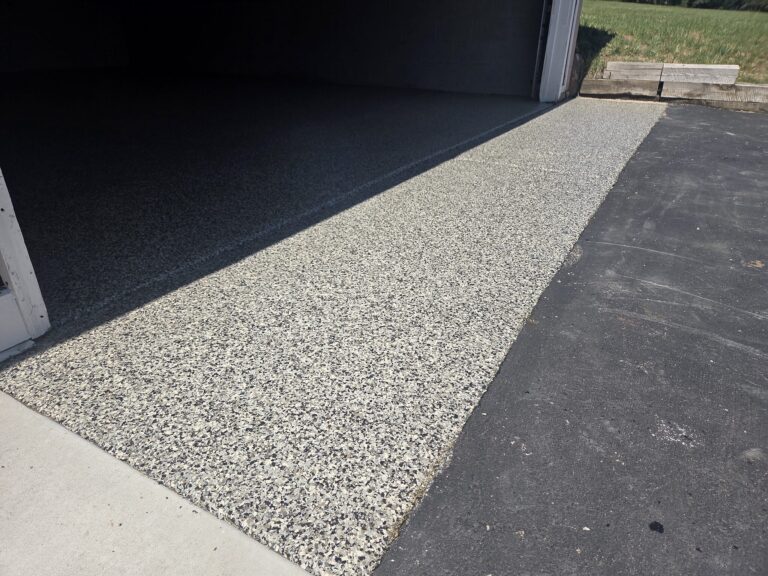
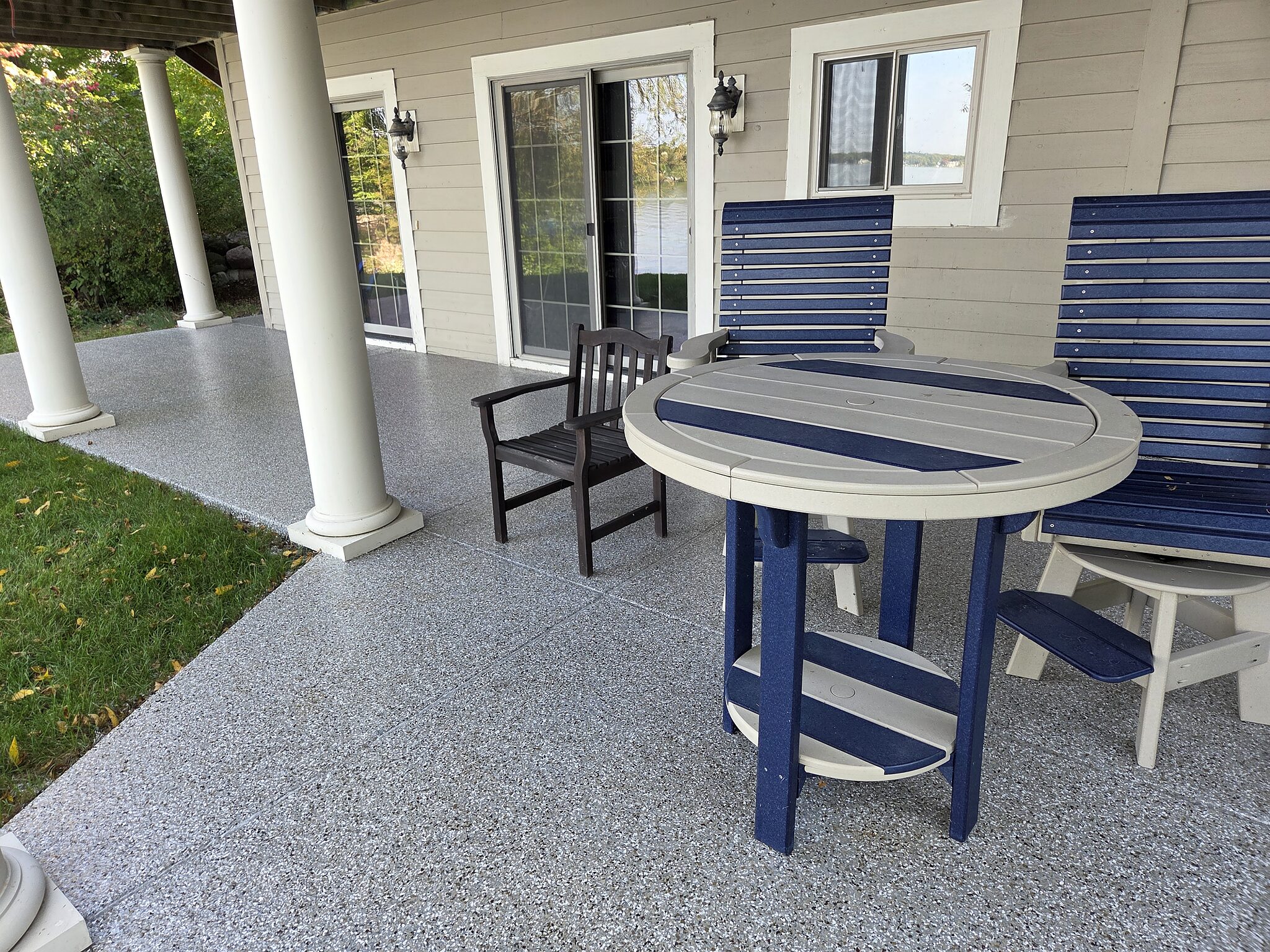
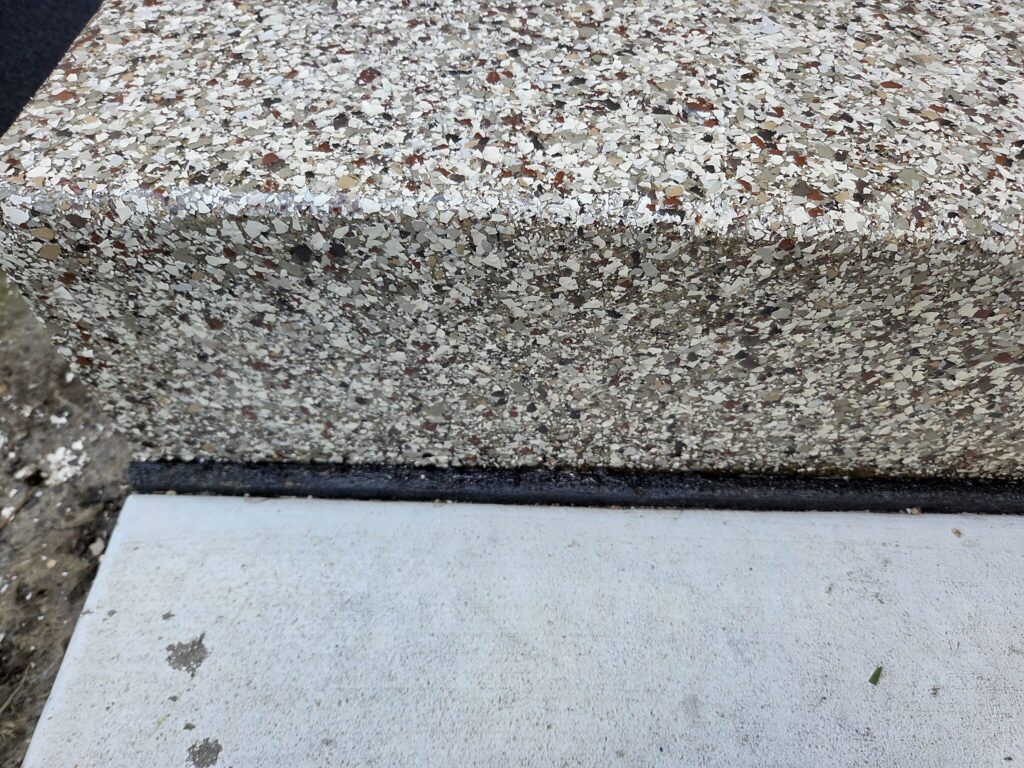
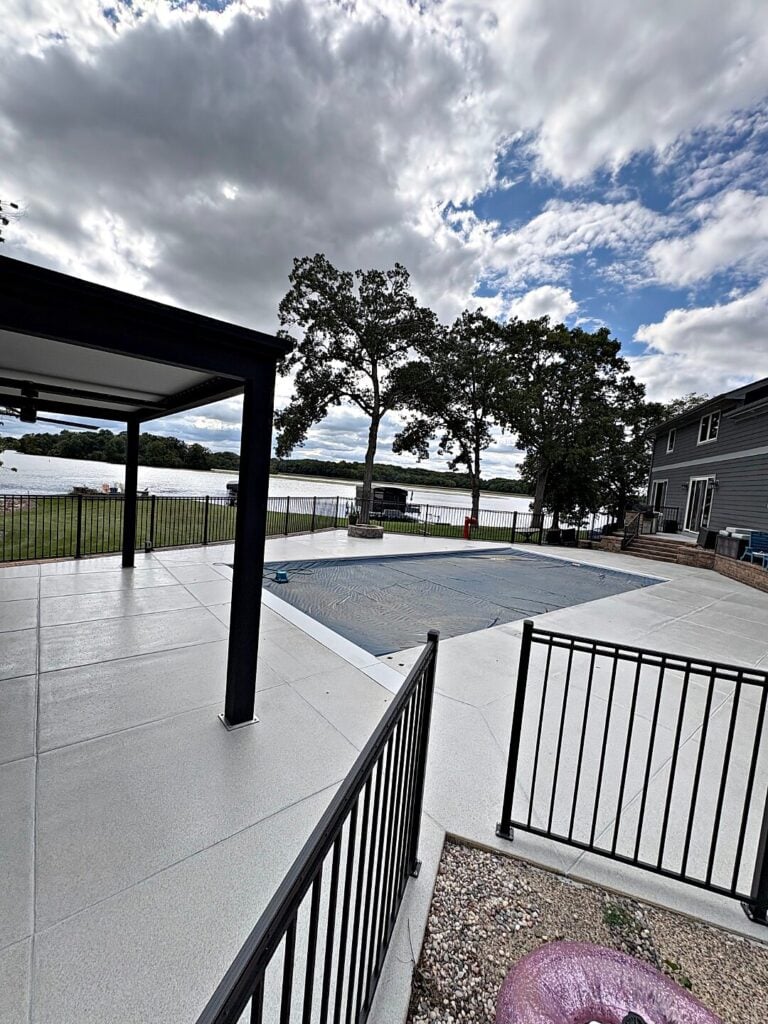
We look at sun exposure, drainage, cracks and moisture before recommending a system, use a UV-stable topcoat where sun reaches the floor, build traction into the wear coat, and schedule the work for suitable temperatures and dew point. Recent outdoor work includes a covered porch in Oconomowoc, a covered patio in Waterford and an entry step in Eagle. Learn more about epoxy and floor coatings.
What should you share for an estimate?
- Whether the area is covered or open, and how much sun it gets.
- Approximate size, steps, and any posts, drains or edges.
- Cracks, flaking, old paint or sealer, and spots that stay wet.
- Photos of the whole area and close-ups of problem spots.