What is the difference between deck stain and deck paint?
Stain soaks into the wood; paint sits on top of it as a film. Between them sits solid-color stain, which hides the grain like paint but is thinner and, in deck formulas, designed for horizontal boards.
| Semi-transparent stain | Solid deck stain | Porch and floor paint | |
|---|---|---|---|
| Look | Color with visible wood grain | Opaque color; texture shows, grain mostly hidden | Opaque color and an even film |
| How it ages | Fades and wears away; does not blister or peel | A thin film that can wear through and peel on traffic areas | A thicker film that can blister and peel if moisture gets behind it |
| Recoating | Clean and recoat; little scraping | Clean, remove loose finish, recoat | Scrape and sand peeling areas first; bare spots need primer |
| Best use | Deck floors and steps, especially newer or weathered wood | Older decks with an existing solid finish or mismatched boards | Railings, posts, skirting; porch floors with products made for them |
The USDA Forest Products Laboratory, which is based in Madison, is blunt about deck floors: “penetrating finishes, not film-forming finishes, should be used on wood decks,” because film-forming finishes such as paint and solid-color stain “are prone to trap moisture and fail by peeling.” It adds that “paints and solid-color stains may perform quite well on the railings.” USDA FPL, Finishes for Wood Decks.
How long does deck stain last compared with paint?
On a deck floor, a semi-transparent stain lasts about 2 to 6 years before it needs recoating, according to the Forest Products Laboratory; paint and solid stain are rated “low” suitability for decking, with no expected life given. The Wood Handbook’s finish table lists semi-transparent stain at about 2–3 years on new, smooth-sawn decking and 3–6 years on weathered or saw-textured boards, for an average U.S. location. Wood Handbook, table 16-4.
Be wary of claims that deck paint lasts ten years or more. The longer figures in that same table apply to vertical siding, not to boards that are walked on, shoveled and soaked. Wear is concentrated where people walk: steps, the path to the door and around the grill go first, while railings last much longer.
When does a solid deck stain make sense?
When the deck already has a solid or painted finish, or the boards are too mismatched or weathered for a see-through stain to look good. A semi-transparent stain cannot penetrate an existing film, so switching an older solid-stained deck back to a transparent look means stripping or sanding the old finish off completely. The Wood Handbook warns, “Unless specially formulated for use on decks, solid-color stains should not be used on decks or porches,” so use a solid stain labeled for deck floors. Wood Handbook, chapter 16.
Deck-rated solid stains spell out their own limits. Benjamin Moore’s Arborcoat Solid, for example, can go over previously painted and stained wood in good condition, but “if general peeling is present on decks all previous coatings should be removed,” and it allows 48 hours before furniture goes back. Arborcoat Solid 640 data sheet (PDF). Expect a solid stain on the floor to need maintenance sooner than the same stain on the railings.
Can you paint a deck?
You can, with a porch and floor paint made for horizontal wood, but plan on more maintenance than stain. PPG’s Floor & Porch Enamel, for instance, is labeled for “decks, steps, and porches,” needs two coats on bare wood with the first acting as primer, should be kept free of standing water for a week, and warns, “Do not use on surfaces that are frequently damp” and that blistering and peeling “are commonly caused by moisture behind the paint film.” PPG 3-510XI data sheet (PDF). Covered porches with good drainage suit paint far better than an open deck in full weather.
Can you stain over paint, or paint over stain?
- Semi-transparent stain over paint or solid stain: no. “Do not apply oil-based semitransparent stains over solid-color stain or paint,” says the Wood Handbook; it cannot soak through a film. Remove the old finish first. Wood Handbook.
- Solid stain or paint over an old semi-transparent stain: usually yes, once the deck is cleaned, weathered gray fibers are removed and the wood is dry, because film-forming finishes “do not bond to weathered areas.”
- Anything over peeling finish: no. Loose coating has to come off, or the new coat peels with it.
What about thick deck resurfacer coatings?
Thick “resurfacer” or “restore” coatings promise to fill cracks and cover worn boards in one heavy layer. Two of the best-known products were the subject of class-action settlements over alleged peeling and failure: Behr DeckOver (Bishop v. Behr Process Corp., N.D. Ill., final approval December 2018) and Rust-Oleum Restore (a $9.3 million settlement in MDL 2602, N.D. Ill., 2016). Settlements are not findings of defect, but the physics is the same as paint: a heavy film over moving, wet wood depends entirely on the wood underneath. A resurfacer is not a substitute for repairing or replacing damaged boards.
When can you stain a new pressure-treated deck?
As soon as the wood is dry enough to absorb the finish, which a simple water test will tell you. Sprinkle a few drops of water on the boards: if they soak in quickly, the wood is ready; if they bead, wait. Benjamin Moore’s Arborcoat sheet uses that same water test and sets a limit of below 15% wood moisture. Arborcoat data sheet.
The old advice to wait six months to a year is not a rule. University of Missouri Extension notes that dry waterborne-treated lumber can be finished before any weathering. MU Extension (PDF). The Forest Products Laboratory suggests letting boards weather 2 to 3 months when they came with a factory water repellent, and warns that waiting up to a year invites “significant checking.” USDA FPL. New, smooth boards may also need light sanding or a brightener to remove mill glaze.
When can you stain a deck in Wisconsin?
Late spring through early fall, on dry days within the product’s temperature range, with no rain expected while it dries. Temperature limits differ by product: Arborcoat Solid can be applied down to 40°F, while PPG’s floor and porch paint needs at least 50°F and 5° above the dew point. Arborcoat; PPG. After washing, the Forest Products Laboratory recommends allowing “at least 2 warm, windy days to dry.” In fall, cool nights, heavy dew and short drying days are usually what end the season, not the afternoon high. See how late in the year you can paint outside in Wisconsin.
How much does it cost to stain a deck?
Our planning range for staining a deck of about 300–400 square feet is $720–$1,920. Where a deck falls depends on how much old finish has to be stripped, board repairs, and whether stairs and railings are included; railings and balusters take far longer per square foot than open floor boards. Switching from a solid finish back to a see-through stain costs more, because the old film has to come off completely.
How Midwest Painting Pros handles deck staining
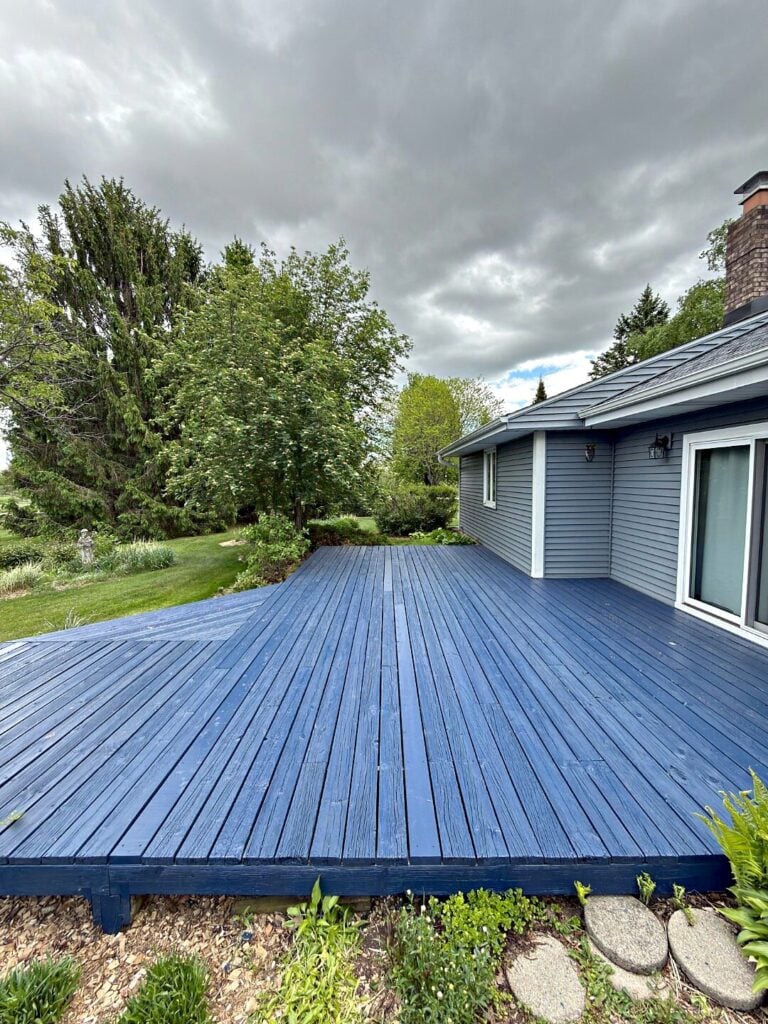
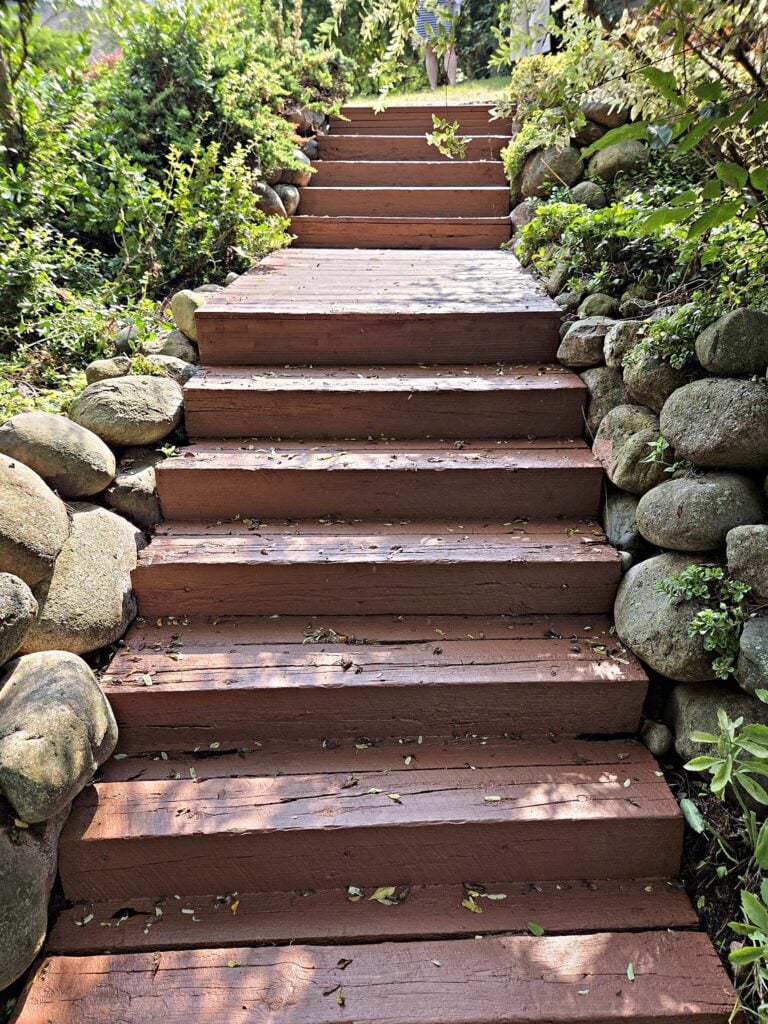
We start with what is on the deck now: a see-through stain, a solid finish, or bare and weathered wood. That decides whether the deck can take a penetrating stain or needs a deck-rated solid stain, and how much cleaning and removal comes first. Recent work includes cedar and treated-lumber decks and stairs in Waukesha refinished with a solid deck stain, and a blue-gray deck in Oconomowoc. Damaged boards are flagged for carpentry repair before any finish goes on. Learn more about our deck and fence staining service.